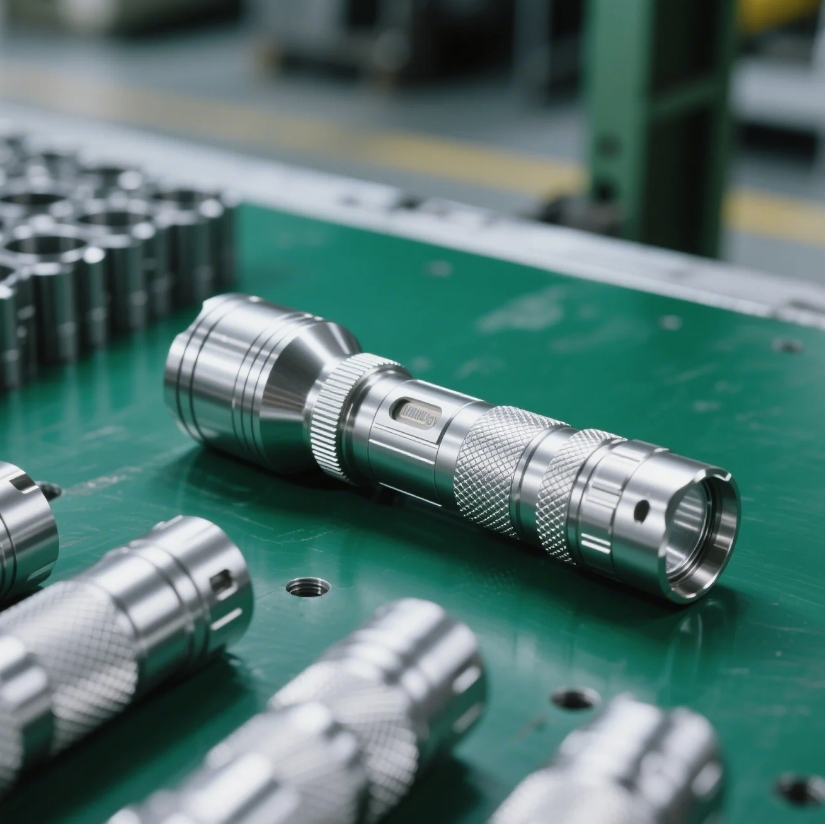
Flashlights are small products, but their design and manufacturing require high precision. A flashlight body must be strong, lightweight, comfortable to hold, and able to protect internal electronic parts. For this reason, CNC Machining Flashlights has become a popular manufacturing solution for companies that need reliable and high-performance flashlight products.
CNC machining allows manufacturers to create complex flashlight structures with accurate dimensions and excellent surface finishes. From the outer body and grip patterns to battery threads and heat dissipation designs, CNC technology provides the flexibility needed for both custom flashlights and mass production.
This article explains the key factors involved in producing CNC-machined flashlights, including design, material selection, machining processes, cost control, and quality inspection. Understanding these factors helps product designers and businesses choose the right manufacturing method and avoid common production problems.
Flashlights often require a combination of mechanical strength, precise assembly, and attractive appearance. Traditional manufacturing methods may have limitations when creating customized shapes or detailed features. CNC machining solves these problems by using computer-controlled machines to remove material with high accuracy.
The advantages of CNC machining for flashlight production include:
For businesses developing professional lighting products, CNC machining provides a balance between design freedom, durability, and production efficiency.
Good flashlight design is not only about appearance. A successful product must be comfortable, practical, and able to work reliably in different environments. Careful design for CNC-machined flashlights helps reduce manufacturing problems and improves the user experience.
A flashlight should feel comfortable in the user's hand. The body diameter, surface texture, and overall shape directly affect grip and operation.
CNC machining makes it possible to create precise grip patterns and customized body shapes without sacrificing strength.
The location of switches and internal components is important for usability. A rear switch design may allow one-handed operation, while a side switch can be easier to access when the flashlight is held in different positions.
During the design stage, engineers should consider:
LED flashlights generate heat during operation. Poor heat management can reduce LED performance and product lifespan. CNC machining can create heat sinks, cooling fins, and special surface structures that improve thermal performance.
A well-designed aluminum flashlight body can work as a heat transfer structure, helping move heat away from the LED module.
Material selection in flashlight CNC directly affects the product's weight, strength, machining difficulty, appearance, and final cost. The most common materials are aluminum and stainless steel.
Aluminum is widely used in flashlight manufacturing because it offers a good balance of performance and cost.
However, aluminum is softer than steel, so manufacturers must choose suitable cutting tools and machining parameters to prevent scratches or deformation.
Stainless steel is another common choice for high-end flashlights that require extra strength and corrosion resistance.
Compared with aluminum, stainless steel is harder to machine. It requires stronger cutting tools, slower cutting speeds, and better process control to maintain accuracy and surface quality.
The machining processes for flashlight CNC usually include turning, milling, threading, and surface finishing. Each process creates specific features needed for flashlight performance.
CNC turning is usually the first major process because most flashlights have a cylindrical body. During turning, the material rotates while cutting tools remove material to create the basic shape.
Common tools used in flashlight turning include:
Appropriate cutting parameters are important. Cutting speed, feed rate, and depth of cut must be adjusted according to the material. Aluminum can usually be machined at higher speeds, while stainless steel requires more careful settings to avoid tool wear.
After turning, milling creates additional details that cannot be produced by simple rotation.
Milling operations may include:
Threading is essential for flashlight parts such as battery caps, lens holders, and tail switches. Accurate threads ensure proper assembly, sealing, and long-term durability.
Other finishing processes may include:
Handling challenges in flashlight CNC requires careful planning because flashlights contain both visible external surfaces and sensitive internal spaces.
Users expect flashlights to have a clean and attractive appearance. Tool marks, scratches, or uneven surfaces can reduce product value.
Manufacturers can improve surface quality by:
Flashlights often contain LED modules, circuit boards, seals, and battery contacts. Incorrect machining processes can damage these areas.
Solutions include:
The cost of CNC Machining Flashlights depends on several factors, including material choice, production volume, design complexity, and machining time.
To achieve cost-effective production, companies can:
Quality control in CNC-machined flashlights is essential to ensure reliable performance and customer satisfaction. A professional manufacturer checks both mechanical accuracy and final product functions.
During machining, technicians inspect important measurements such as:
Inspection tools such as calipers, micrometers, and coordinate measuring machines help maintain consistent production quality.
Before delivery, finished flashlights should be tested for performance and reliability.
Common tests include:
Selecting an experienced CNC machining supplier is important for producing high-quality flashlights. A reliable partner should understand material behavior, machining accuracy, surface finishing, and product testing requirements.
Companies such as EMAR provide CNC machining experience for customized metal parts, helping customers develop flashlight products with accurate machining, efficient production methods, and reliable quality control. Working with an experienced manufacturer can reduce development risks and improve product performance.
CNC Machining Flashlights provides an effective way to produce durable, precise, and visually attractive lighting products. From ergonomic design and material selection to turning, milling, finishing, and inspection, every manufacturing step affects the final flashlight quality.
By understanding design for CNC-machined flashlights, material selection in flashlight CNC, machining processes for flashlight CNC, and quality control in CNC-machined flashlights, businesses can create better products while controlling production costs. With the right CNC machining partner, customized flashlight designs can become reliable products ready for demanding applications.