Benefits of Five Axis CNC Machining: Improve Precision, Efficiency, and Manufacturing Flexibility
The Benefits of Five Axis CNC Machining have made this technology one of the most important manufacturing solutions for industries that require high precision and complex parts. Aerospace, medical, automotive, energy, robotics, and mold manufacturing all rely on five-axis CNC machining to produce components that meet strict quality standards.
Many manufacturers wonder whether investing in five-axis machining is worthwhile. Common questions include:
- Can it really improve machining accuracy?
- Does it reduce production time?
- Is it suitable for complex parts?
- Can it lower overall manufacturing costs?
The answer is yes. When properly applied, five-axis CNC machining improves product quality while reducing unnecessary production steps. This article explains the major advantages using simple language and practical examples.
Why Five Axis CNC Machining Is Important
Traditional three-axis CNC machines move the cutting tool in the X, Y, and Z directions. However, many modern parts have curved surfaces, deep cavities, angled holes, or complex geometries that require multiple setups.
Five-axis CNC machining adds two rotational axes, allowing the cutting tool to approach the workpiece from many different angles during one machining cycle.
This capability brings significant improvements in:
- Machining precision
- Production efficiency
- Design flexibility
- Cost control
- Surface finish quality
For manufacturers producing high-value components, these advantages often outweigh the higher machine investment.
Precision Benefits of Five-Axis CNC
Achieving Tight Tolerances
One of the biggest precision benefits of five-axis CNC machining is its ability to maintain extremely tight tolerances.
Instead of repeatedly removing and repositioning a workpiece, the machine completes multiple operations in one setup. Every time a part is moved manually, small positioning errors may occur. Five-axis machining greatly reduces these errors.
For example, aerospace turbine blades often require tolerances as small as ±0.05 mm. Because the cutting tool can approach the blade from the best angle, the machine produces accurate dimensions while maintaining excellent surface quality.
This level of precision is essential for industries where even a tiny error may affect performance or safety.
Consistent Accuracy for Every Part
Another major advantage is repeatability.
Since the machining program controls every movement, thousands of identical parts can be produced with nearly identical dimensions.
For example, dental implants must match precise medical specifications. Five-axis CNC machining allows manufacturers to produce each implant with consistent size, shape, and surface finish.
This consistency reduces rejected parts and improves customer confidence.
Efficiency Gains in Five-Axis CNC Machining
Reduced Setup Time
One of the most valuable efficiency gains in five-axis CNC machining is completing multiple operations in one setup.
With traditional machining, operators may need to:
- Remove the workpiece
- Install a new fixture
- Reset the workpiece position
- Measure alignment again
- Continue machining
Each setup consumes valuable production time.
Using a five-axis machine, rough milling, finishing, drilling, tapping, and contour machining can often be completed without removing the workpiece.
For example, a complex mold that once required several machines can now be completed on one five-axis machining center.
The result is shorter lead times and higher production capacity.
Faster Material Removal
Five-axis machines also improve cutting efficiency.
Because the tool approaches the workpiece from optimal angles, shorter cutting tools can often be used. Shorter tools are more rigid, allowing higher cutting speeds while reducing vibration.
For example, when machining a large aluminum structural component, the machine can continuously adjust tool orientation to maintain efficient cutting conditions.
This reduces machining time while improving surface quality.
Flexibility Advantages of Five-Axis CNC
Machining Complex Shapes
The greatest flexibility advantages of five-axis CNC machining appear when producing complex geometries.
Many products contain:
- Curved surfaces
- Deep cavities
- Angled holes
- Organic shapes
- Undercuts
These features are difficult or impossible to machine efficiently using only three axes.
For example, jewelry manufacturers often create detailed decorative patterns with flowing curves and intricate surfaces. Five-axis machining allows the cutting tool to reach these areas smoothly, producing attractive finished products.
Manufacturing Integrated Parts
Five-axis machining also allows engineers to redesign assemblies into single components.
For example, instead of manufacturing several engine manifold sections and joining them through welding or bolts, the manifold can often be machined as one complete part.
This provides several benefits:
- Higher structural strength
- Fewer assembly operations
- Lower assembly cost
- Improved reliability
- Reduced inspection requirements
Cost-Effectiveness in Five-Axis CNC
Lower Labor and Tooling Costs
Many people believe five-axis machining is expensive simply because the equipment costs more.
However, the overall cost-effectiveness in five-axis CNC production often makes it the more economical choice.
Because operators spend less time changing fixtures, aligning workpieces, and transferring parts between machines, labor costs decrease.
In many projects, fewer specialized fixtures and cutting tools are also required, lowering tooling expenses.
Although machine investment is higher, production costs per part often decrease for medium and high-volume manufacturing.
Reduced Material Waste
Material costs continue to increase, especially for titanium, stainless steel, aluminum alloys, and aerospace materials.
Five-axis machining optimizes cutting paths and minimizes unnecessary material removal.
For example, when machining a complex aerospace bracket, improved tool positioning helps reduce excess stock removal while maintaining part strength.
Lower scrap rates directly reduce production costs while supporting more sustainable manufacturing.
Complex-Shape Machining in Five-Axis CNC
Producing Advanced Geometries
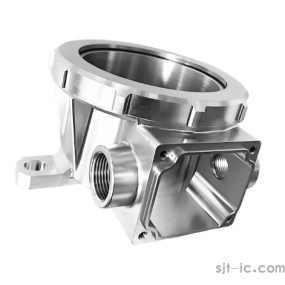
Complex-shape machining in five-axis CNC enables manufacturers to create products that cannot easily be produced using conventional machining.
One example is automotive engine components with internal cooling channels.
The additional rotational axes allow the cutting tool to machine these internal features accurately, improving coolant flow and engine efficiency.
Similar applications include:
- Aerospace structural parts
- Medical implants
- Aircraft engine components
- Turbine blades
- Precision molds
Ideal for Custom Manufacturing
Customer demand for customized products continues to grow.
Five-axis machining allows manufacturers to produce low-volume and custom-designed components efficiently without sacrificing quality.
For example, surgeons may require customized medical instruments designed for specific procedures. Five-axis CNC machining can manufacture these unique tools accurately while maintaining strict quality standards.
This flexibility helps manufacturers respond quickly to changing customer requirements.
Industries That Benefit Most from Five-Axis CNC Machining
- Aerospace — turbine blades, structural components, housings
- Medical — implants, surgical tools, orthopedic devices
- Automotive — engine parts, transmission components, molds
- Energy — valves, pump components, turbine parts
- Electronics — precision housings and heat sinks
- Mold Manufacturing — complex molds with detailed cavities
- Robotics — lightweight precision mechanical parts
How EMAR Maximizes the Benefits of Five Axis CNC Machining
Successfully applying the Benefits of Five Axis CNC Machining requires more than advanced equipment. It also depends on experienced engineers, optimized machining strategies, quality inspection, and strict process control.
EMAR combines skilled technical teams with advanced five-axis CNC machining capabilities to manufacture precision components for demanding industries.
Whether producing aerospace parts with extremely tight tolerances or custom industrial components with complex geometries, EMAR carefully selects machining strategies that improve precision, shorten production time, and maintain consistent quality.
Customers benefit from:
- High machining accuracy
- Stable product quality
- Efficient production scheduling
- Reliable delivery performance
- Professional engineering support
Every project follows strict quality control procedures to ensure finished parts meet customer specifications and international manufacturing standards.
Conclusion
The Benefits of Five Axis CNC Machining extend far beyond simply adding two extra machine axes. The technology improves precision, reduces setup time, increases machining speed, supports highly complex geometries, lowers production costs, and enables manufacturers to produce integrated, high-performance components.
From the precision benefits of five-axis CNC to the efficiency gains in five-axis CNC machining, the flexibility advantages of five-axis CNC, the cost-effectiveness in five-axis CNC, and advanced complex-shape machining in five-axis CNC, this manufacturing method continues to help companies remain competitive in modern industry.
For businesses seeking reliable, high-quality precision machining, partnering with an experienced manufacturer like EMAR ensures these advantages are fully utilized to produce durable, accurate, and cost-effective components that meet demanding application requirements.