
What are the advantages of CNC five - axis machining?
Understanding What are the advantages of CNC five - axis machining? is important for manufacturers who need higher quality, faster production, and more design freedom. As product designs become more complex, traditional machining methods may require multiple setups, extra fixtures, and additional processing steps. CNC five - axis machining provides a more advanced solution by allowing the cutting tool to move along five different axes, making it possible to machine difficult parts with higher accuracy and efficiency.
For industries such as aerospace, medical, automotive, and precision manufacturing, choosing the right machining method can directly affect product performance and production costs. By understanding the benefits of CNC five - axis machining, manufacturers can make better decisions, improve competitiveness, and produce reliable high-quality components.
Precision benefits of CNC five - axis machining
One of the most important advantages of CNC five - axis machining is its ability to achieve excellent precision. Unlike traditional machining methods that often require repositioning the workpiece several times, five - axis CNC machines can approach the part from different angles in one setup. This reduces alignment errors and improves overall machining accuracy.
Tight tolerance achievement
CNC five - axis machining can achieve extremely tight tolerances, which is essential for industries where small dimensional errors can affect product performance. For example, aerospace manufacturers often produce turbine blades that require very accurate shapes and dimensions. The five - axis machine can adjust the cutting tool angle continuously, allowing it to create complex blade surfaces with high precision.
In many applications, tolerances as small as ±0.05mm can be achieved. A turbine blade with incorrect dimensions may reduce engine efficiency or create safety risks. Five - axis machining helps ensure that every blade matches the required design specifications.
High precision is also important in medical manufacturing. For example, dental implants and surgical components must have accurate dimensions to ensure proper fitting and reliable performance. CNC five - axis machining provides the accuracy needed for these demanding applications.
Consistent precision across parts
Another major advantage is consistent quality during repeated production. Because CNC five - axis machines are controlled by computer programs, they can repeat the same machining process with very little variation.
For example, when producing dental implants, every implant needs to have the same shape and size. A five - axis CNC machine can produce hundreds or thousands of identical parts while maintaining stable accuracy. This reduces defects, improves product reliability, and helps manufacturers maintain consistent quality.
Efficiency gains in CNC five - axis machining
The efficiency gains in CNC five - axis machining make it a valuable choice for manufacturers that need faster production and shorter delivery times. By reducing unnecessary operations and improving cutting methods, five - axis machining can increase overall manufacturing efficiency.
Reduced setup time in CNC five - axis machining
A common challenge in traditional machining is the need to move a part between different machines or change fixtures for different operations. Each repositioning step takes time and can introduce accuracy problems.
With CNC five - axis machining, many operations can be completed in a single setup. For example, when manufacturing a complex mold, milling, drilling, and surface machining can often be completed without removing the workpiece from the machine. This reduces setup time and allows manufacturers to produce more parts within the same working period.
The reduced setup time in CNC five - axis machining also helps shorten production cycles. Faster processing allows companies to respond more quickly to customer orders and improve delivery performance.
Faster machining speeds
Five - axis CNC machines can improve machining speed because the cutting tool can reach different areas of a workpiece without requiring manual repositioning. The machine can select better cutting angles and follow more efficient tool paths.
For example, when machining a large aluminum aerospace component, a five - axis CNC machine can smoothly move around the part and remove material more efficiently. This reduces machining time while maintaining excellent surface quality.
Faster machining speeds help manufacturers increase production capacity, reduce labor costs, and improve overall profitability.
Flexibility advantages of CNC five - axis machining
The flexibility advantages of CNC five - axis machining allow manufacturers to create parts that are difficult or impossible to produce using conventional machining methods. The additional rotational movements give engineers more freedom when designing complex components.
Complex - shape - making capabilities of CNC five - axis machining
One of the biggest strengths of five - axis machining is its ability to produce complex geometries. Traditional machines may struggle with deep cavities, curved surfaces, and unusual angles because the cutting tool cannot easily reach these areas.
Five - axis CNC machines solve this problem by allowing the tool to approach the workpiece from multiple directions. For example, in the jewelry industry, manufacturers can create detailed patterns, smooth curves, and unique decorative designs that require precise tool movement.
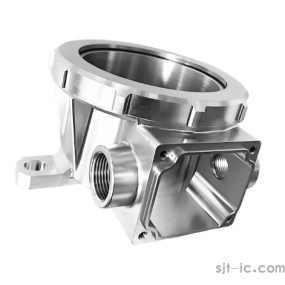
The complex - shape - making capabilities of CNC five - axis machining are also valuable in aerospace and high-tech industries, where lightweight structures and advanced designs are often required.
Integrated part design and manufacturing
Another flexibility advantage is the ability to manufacture integrated parts as a single component instead of assembling multiple smaller pieces.
For example, a high-performance engine manifold can be machined as one complete part using five - axis CNC technology. Traditional methods may require several pieces to be manufactured separately and then welded or connected together. A single-piece design can improve strength, reduce assembly work, and lower the risk of failure.
Integrated manufacturing helps companies reduce production steps while improving the reliability of the final product.
How reduced setup time improves CNC five - axis machining results
Single - setup machining
Single - setup machining is one of the key reasons manufacturers choose five - axis CNC technology. Completing multiple operations without moving the workpiece reduces the possibility of positioning errors.
For example, a component with holes, slots, and curved surfaces can often be finished in one setup. The machine does not need to stop for fixture changes or manual adjustments, resulting in better accuracy and higher productivity.
This approach improves both machining quality and production efficiency because fewer setup changes mean fewer opportunities for mistakes.
Simplified fixturing requirements
Five - axis machining can also reduce the need for complicated fixtures. Traditional machining may require different fixtures to hold a part in multiple positions. This increases preparation time and adds manufacturing costs.
With five - axis machining, a simpler fixture can often hold the workpiece while the machine accesses different surfaces automatically. This is especially useful for small-batch production, prototypes, and customized components.
Simplified fixturing makes the machining process easier to manage and helps reduce overall production expenses.
EMAR's proficiency in CNC five - axis machining
Selecting an experienced machining partner is essential for achieving the full benefits of CNC five - axis technology. EMAR has professional experience in CNC Machining and focuses on providing high-quality precision machined parts for different industries.
Advanced machining expertise
EMAR's engineering team understands how to optimize five - axis machining processes, including tool path planning, cutting parameter selection, and quality control. This expertise helps customers take advantage of the precision, efficiency, and flexibility offered by five - axis machining.
For industries such as medical, aerospace, and automotive manufacturing, EMAR can support the production of complex parts that require strict dimensional accuracy and reliable performance.
Quality-assured machining services
Quality control is a critical part of CNC five - axis machining. EMAR applies inspection procedures throughout the manufacturing process to ensure that finished parts meet customer requirements.
From checking dimensions and surface finishes to performing final inspections, EMAR focuses on delivering dependable machined components. This quality-focused approach helps customers receive parts that are accurate, durable, and ready for their intended applications.
Conclusion: Why choose CNC five - axis machining?
The advantages of CNC five - axis machining include higher precision, faster production, greater design flexibility, reduced setup time, and the ability to manufacture complex parts. These benefits make it an ideal solution for industries that require advanced manufacturing capabilities.
By choosing an experienced provider such as EMAR, manufacturers can access professional CNC five - axis machining expertise and receive high-quality parts that meet demanding industry standards. As product designs continue to become more complex, five - axis machining will remain an important technology for improving manufacturing performance and competitiveness.