Spanish
 Arabic
 French
 Portuguese
 Belarusian
 Japanese
 Russian
 Malay
Malay Icelandic
 Bulgarian
 Azerbaijani
 Estonian
 Irish
Irish Polish
 Persian
 Boolean
 Danish
 German
 Filipino
 Finnish
 Korean
 Dutch
Dutch Galician
 Catalan
 Czech
Czech Croatian
 Latin
Latin Latvian
 Romanian
 Maltese
 Macedonian
 Norwegian
 Swedish
 Serbian
 Slovak
 Slovenian
 Swahili
 Thai
Thai Turkish
 Welsh
Welsh Urdu
Urdu Ukrainian
 Greek
Greek Hungarian
 Italian
 Yiddish
 Indonesian
 Vietnamese
 Haitian Creole
 Spanish Basque

HTML
Nut CNC Custom Machining: A Complete Guide to Precision Custom Nuts
When standard nuts cannot meet special requirements, Nut CNC Custom Machining provides a reliable solution for creating nuts with exact sizes, special shapes, and high performance. Many industries need custom nuts that can handle specific loads, fit unique bolts, and work safely in demanding environments. However, customers often worry about thread accuracy, material choice, production cost, and whether the finished nut will perform correctly.
CNC Machining solves these problems by using computer-controlled machines to produce highly accurate custom nuts. With advanced equipment, professional programming, and strict inspection processes, manufacturers can create nuts that match precise engineering drawings and application needs.
Why CNC Machining Is a Good Choice for Custom Nut Production
CNC machining is widely used for custom nut manufacturing because it offers excellent precision, flexibility, and repeatability. Unlike traditional methods that may require complex tooling, CNC machines can quickly produce different nut designs by changing the machining program.
- High precision: CNC machines can achieve tight dimensional tolerances, helping nuts fit bolts correctly and maintain stable connections.
- Flexible designs: CNC machining can produce standard hex nuts, round nuts, square nuts, flange nuts, and other special shapes.
- Small and large production runs: It is suitable for prototypes, low-volume custom orders, and mass production.
- Consistent quality: Computer-controlled processes reduce human errors and maintain the same quality across every part.
For companies that need reliable custom fastening solutions, working with an experienced manufacturer such as EMAR can help ensure accurate production, efficient machining processes, and professional quality management.
Design Considerations for Nut CNC Custom Machining
Good design is the first step to producing a functional custom nut. The design considerations for nut CNC custom machining should focus on the working environment, load requirements, and the matching bolt specifications.
1. Understanding the Application Requirements
The intended use of the nut directly affects its design. Different industries require different performance characteristics.
- Automotive engines: Nuts used in engines must handle vibration, heat, and high mechanical loads. Strong materials and accurate threads are important for safety.
- Construction machinery: Heavy equipment requires nuts with high load capacity and excellent durability.
- Furniture and equipment: Custom nuts for furniture may focus more on appearance, easy installation, and corrosion resistance.
2. Matching Bolt Size and Thread Specifications
A custom nut must perfectly match its mating bolt. Important design factors include:
- Thread diameter: The inside diameter must match the bolt size to create a secure connection.
- Thread pitch: The distance between threads affects strength, assembly speed, and vibration resistance.
- Nut length: A longer nut can provide stronger engagement when higher loads are required.
- Nut shape: Hexagonal, square, round, flange, or special shapes should be selected based on installation space and application needs.
Incorrect thread dimensions can cause loose connections, difficult assembly, or premature failure. Therefore, accurate design drawings and professional machining support are essential.
Material Selection for Custom Nut CNC
The material selection for custom nut CNC has a major influence on strength, service life, cost, and environmental resistance. The best material depends on the application conditions.
Steel Nuts
Steel is one of the most common materials for custom nuts because it provides high strength and good cost performance. Steel nuts are suitable for automotive parts, machinery, and heavy-duty applications where high load capacity is needed.
Stainless Steel Nuts
Stainless steel offers excellent corrosion resistance and maintains good mechanical properties in harsh environments. It is often used in outdoor equipment, marine applications, food processing machines, and medical devices.
Aluminum Nuts
Aluminum is lightweight and has good corrosion resistance. It is a good choice when reducing overall weight is important, such as in aerospace components, electronic equipment, and lightweight mechanical structures.
Brass Nuts
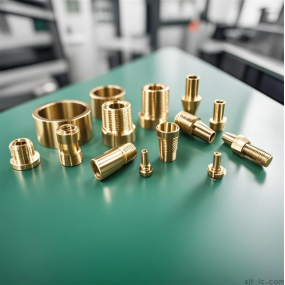
Brass provides good corrosion resistance, electrical conductivity, and an attractive appearance. It is commonly used in decorative equipment, electrical applications, and low-friction fastening systems.
Professional CNC manufacturers can recommend suitable materials based on strength requirements, operating environment, budget, and production quantity.
Main Machining Operations for Custom CNC Nuts
Nut CNC machining usually includes several important operations. Each process must be carefully controlled to achieve the required dimensions and performance.
Turning
Turning is often used to create the basic outer shape and inner diameter of the nut. CNC lathes remove material from rotating stock to achieve accurate round surfaces and dimensions.
Threading
Threading creates the internal threads that connect with bolts. This is one of the most important steps because thread errors can prevent proper assembly.
Handling thread accuracy in nut CNC requires careful tool selection, correct machining parameters, and regular inspection. Thread cutting tools, tapping tools, or thread milling tools must be selected according to the material and thread requirements.
Milling
Milling creates special external shapes, slots, flats, or complex features. It is especially useful for customized nuts that require more than a standard hex shape.
Machining Parameters
Cutting speed, feed rate, and depth of cut must be optimized according to the material and tool type.
- Cutting speed: Higher speeds may improve efficiency but must be controlled to avoid excessive heat or tool wear.
- Feed rate: Proper feed rates help achieve smooth surfaces and accurate dimensions.
- Depth of cut: Suitable cutting depths improve machining stability and reduce tool stress.
Experienced CNC technicians adjust these parameters based on material hardness, part size, thread requirements, and production goals.
Common Challenges in Nut CNC Custom Machining
Maintaining Accurate Thread Dimensions
Thread accuracy is one of the biggest challenges in custom nut production. Even small errors in thread diameter, pitch, or angle can affect bolt engagement. Using precision tools and thread inspection equipment helps maintain reliable performance.
Preventing Burr Formation
Burrs can affect assembly quality and create safety problems. Proper cutting conditions, sharp tools, and deburring processes help produce clean and smooth nut surfaces.
Machining Different Materials
Each material has different machining characteristics. Aluminum is soft and may create chips that affect surface quality, while stainless steel can increase tool wear because of its hardness. Selecting suitable tools and machining strategies is necessary for stable production.
Post-Machining Processes for Better Performance
After machining, additional treatments can improve the strength, appearance, and service life of custom nuts.
- Heat treatment: Improves hardness, strength, and wear resistance for heavy-duty applications.
- Surface coating: Provides corrosion protection and improves surface performance. Common options include plating, anodizing, and protective coatings.
- Deburring: Removes sharp edges and improves safety during installation.
Quality Control in Nut CNC Custom Machining
Quality control in Nut CNC custom machining ensures every nut meets customer specifications and performs safely in real applications.
Reliable manufacturers use multiple inspection methods, including:
- Dimensional inspections: Measuring outside diameter, height, thickness, and other critical dimensions.
- Thread gauge checks: Confirming that internal threads match the required bolt specifications.
- Torque testing: Testing fastening performance and connection reliability under working conditions.
- Surface inspections: Checking for scratches, burrs, cracks, or machining defects.
Companies like EMAR apply professional CNC machining experience and quality control systems to help customers receive custom nuts that meet demanding industrial requirements.
Examples of Specialized Custom-Machined Nuts and Their Applications
Custom CNC machining allows manufacturers to produce unique nut designs for special purposes.
- Flange nuts: Used in automotive and machinery applications because the flange provides a larger load distribution area.
- Lock nuts: Designed for applications with vibration, such as engines and industrial equipment.
- Weld nuts: Used in automotive structures where the nut needs to be permanently attached to a metal surface.
- Custom round nuts: Suitable for precision equipment where space limitations require a special shape.
- Decorative brass nuts: Used in furniture, lighting products, and architectural hardware where appearance matters.
Choosing the Right Partner for Custom Nut Production
Successful Nut CNC Custom Machining depends on more than just machine capability. A reliable machining partner should understand engineering requirements, recommend suitable materials, control production accuracy, and provide consistent quality.
EMAR provides CNC machining solutions for customized nuts and precision components, supporting customers with design assistance, material recommendations, advanced machining processes, and inspection services. By combining manufacturing experience with strict quality control, EMAR helps industries create dependable fastening components for various applications.
Custom nuts are critical components in many mechanical systems. With accurate design, proper material selection, optimized machining processes, and strict quality inspections, CNC machining makes it possible to produce nuts that deliver strong performance, reliable fitting, and long service life.