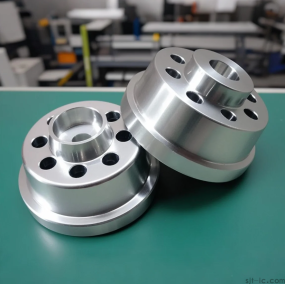
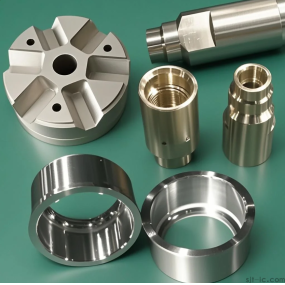
The CNC Titanium Alloy Machining Process Flow is a critical manufacturing sequence used to produce high-precision parts for aerospace, medical devices, automotive systems, and industrial equipment. Titanium alloys are strong, lightweight, and corrosion-resistant, but they are also difficult to machine. Many manufacturers struggle with tool wear, heat control, and surface quality. This article explains the process in simple English and helps you understand how to achieve stable, high-quality results.
Why Titanium Alloy Machining Is Challenging
Titanium alloys are not like normal metals. They create high heat during cutting and quickly wear out tools. This leads to unstable machining and higher cost if the process is not controlled correctly.
- Low thermal conductivity causes heat to stay in the cutting zone
- High strength increases cutting resistance
- Tool wear happens faster than in aluminum or steel machining
- Surface finish can easily be damaged without correct parameters
Because of these issues, a stable CNC Titanium Alloy Machining Process Flow is essential for success.
Steps in CNC Machining of Titanium Alloy
The steps in CNC machining of titanium alloy must be carefully planned to control heat, vibration, and tool wear. Below is a typical workflow used in professional manufacturing.
- Material Preparation – Select high-quality titanium alloy and inspect for defects.
- CAD Design & Programming – Create precise digital models and CNC toolpaths.
- Rough Machining – Remove large material volumes with controlled cutting parameters.
- Semi-Finishing – Improve shape accuracy and reduce machining stress.
- Finishing – Achieve final dimensions and surface quality.
- Inspection – Measure dimensions using precision instruments.
Each step must be controlled carefully to avoid heat accumulation and tool failure.
Tooling Requirements for Titanium Alloy CNC Machining
Tooling requirements for titanium alloy CNC machining are more demanding than standard materials. Using the wrong tool can cause rapid wear or even machining failure.
- Use carbide tools with high heat resistance
- Apply coated tools (TiAlN or AlTiN) for longer tool life
- Keep sharp cutting edges to reduce friction
- Use short tool overhang to improve rigidity
- Apply high-pressure coolant systems when possible
Good tooling selection directly improves machining stability and reduces production cost.
Precision Control in CNC Titanium Alloy Machining
Precision control in CNC titanium alloy machining is essential for parts used in aerospace and medical industries. Even small errors can affect performance and safety.
Key control methods include:
- Using stable fixturing systems to reduce vibration
- Optimizing spindle speed and feed rate
- Applying real-time temperature monitoring
- Compensating tool wear through CNC software
With proper control, manufacturers can achieve tight tolerances and consistent quality across batches.
Challenges and Solutions in CNC Titanium Alloy Machining Flow
The challenges and solutions in CNC titanium alloy machining flow are closely connected. Understanding both sides helps improve efficiency and reduce production risks.
- Challenge: High cutting temperature
Solution: Use coolant-rich machining and optimized cutting paths - Challenge: Tool wear
Solution: Use coated carbide tools and reduce cutting speed - Challenge: Vibration and chatter
Solution: Improve fixture rigidity and reduce tool overhang - Challenge: Poor surface finish
Solution: Apply multi-step finishing and fine feed control
Quality Assurance in CNC Titanium Alloy Machining Process
Quality assurance in CNC titanium alloy machining process ensures every part meets strict industrial standards. Without proper inspection, even small errors can lead to product failure.
Common quality control methods include:
- Coordinate Measuring Machine (CMM) inspection
- Surface roughness testing
- Dimensional tolerance verification
- Material traceability checks
Strong QA systems help reduce rework, improve reliability, and build customer trust.
How EMAR Supports High-Precision Titanium Machining
In modern manufacturing, experience and process control are key. EMAR specializes in advanced CNC titanium alloy machining with a focus on stability, precision, and repeatability. By combining optimized tooling strategies, strict process control, and professional inspection systems, EMAR helps customers achieve reliable results even for complex titanium parts.
Whether it is small batch prototyping or large-scale production, EMAR’s engineering team ensures that every stage of the CNC Titanium Alloy Machining Process Flow is carefully managed to meet demanding industry requirements.
Conclusion
A well-designed CNC Titanium Alloy Machining Process Flow is essential for producing high-quality titanium parts. From tooling selection to precision control and final inspection, each step plays an important role in success. By understanding the process and applying the right solutions, manufacturers can reduce cost, improve quality, and increase production stability.