
Precision Stamping Parts Processing Plants Need to Know the Properties of Which Metal Materials
In precision stamping parts production, choosing the correct metal material is one of the most important steps. Many quality problems, such as cracks, deformation, poor surface finish, and short service life, are directly related to whether the material properties match the stamping requirements.
Precision stamping parts processing plants need to know the properties of which metal materials because metal characteristics determine how easily a material can be formed, how much stamping force is needed, how long the tooling can last, and whether the finished part can meet the requirements of its application.
For example, a metal part used in an automobile safety structure needs high strength, while a connector used in electronic equipment needs excellent electrical conductivity. Understanding mechanical properties for stamping, physical properties, and chemical properties helps manufacturers select suitable materials and avoid production failures.
Why Metal Properties Are Important in Precision Stamping
Precision stamping is a manufacturing process that uses dies and presses to cut, bend, stretch, or shape metal sheets into specific parts. During this process, the metal experiences strong forces and repeated deformation.
If the material is not suitable, several problems may happen:
- The metal may crack during deep drawing or bending.
- The stamped part may lose its designed shape after processing.
- Stamping tools may wear faster because the material is too hard.
- The final product may not have enough strength or corrosion resistance.
Therefore, precision stamping plants must study metal properties before production. Companies with professional material selection experience, such as EMAR, focus on analyzing material characteristics before starting production. This helps ensure stable processing, accurate dimensions, and reliable part performance.
Mechanical Properties for Stamping
Mechanical properties describe how metals react when external forces are applied. They are among the most important factors affecting stamping quality.
Strength
Strength is a metal's ability to resist deformation under pressure or pulling forces. In precision stamping, tensile strength is especially important because stamping operations often stretch and reshape metal sheets.
High-strength materials can handle large stamping forces without breaking. For example, automotive manufacturers often use high-strength steel for vehicle frames. These parts must maintain their shape and provide protection during collisions.
If a material has insufficient strength, problems may occur during stamping. The sheet may stretch too much, become thinner in some areas, or even tear during forming.
During deep drawing operations, such as making metal cups or housings, the correct strength level allows the material to flow smoothly without cracks.
Ductility
Ductility refers to a metal's ability to change shape without breaking. It allows materials to be bent, stretched, and formed into complex designs.
Good ductility is important because many stamped parts require complicated shapes. For example, aluminum sheets used in automobile body panels can be formed into smooth curves because aluminum has excellent ductility.
However, a balance is necessary. If a metal is too soft and flexible, it may not maintain its final shape after stamping. The ideal material should be easy to form but strong enough for actual use.
For example, when producing a stamped metal bracket, the material must bend into the correct angle while still keeping its shape during operation.
Hardness
Hardness measures a metal's resistance to scratching, indentation, and wear. It affects both the stamping material and the stamping tools.
Stamping dies are often made from hard tool steel because they must withstand thousands or even millions of stamping cycles without changing shape.
However, if the stamping material itself is too hard, it can create problems:
- Higher stamping force is required.
- Energy consumption increases.
- Punches and dies wear faster.
- The risk of equipment damage increases.
For example, stamping a very hard alloy without adjusting the tooling design may cause punch breakage or early die failure.
Physical Properties of Stamping Metals
Besides mechanical performance, physical characteristics also influence material selection. These properties are especially important when parts must meet special requirements such as lightweight design or heat control.
Density
Density is the mass of a material in a certain volume. In industries such as aerospace and automotive manufacturing, reducing weight is often a major goal.
Aluminum has a lower density than steel, making it popular for lightweight components. Aircraft manufacturers often use aluminum alloys for structural parts because reducing aircraft weight can improve fuel efficiency.
In precision stamping, density affects material choice and part design. When a lightweight product is required, engineers may select aluminum instead of steel and adjust the stamping process according to the material behavior.
Thermal Conductivity
Thermal conductivity describes how easily a metal transfers heat. This property is important for electronic and heat-management applications.
Copper has excellent thermal conductivity, so it is commonly used for stamped heat sinks, electrical connectors, and electronic components.
During stamping, friction between the metal sheet and the tools can generate heat. Materials with good thermal conductivity can remove heat more effectively and reduce the risk of damage.
However, very fast heat transfer may also affect forming conditions. Therefore, stamping parameters must be carefully controlled.
Chemical Properties in Precision Stamping
Corrosion Resistance
Corrosion resistance is the ability of a metal to resist chemical damage caused by moisture, chemicals, or environmental conditions.
This property is essential in industries such as food processing, medical equipment, and outdoor products. Stainless steel is widely used because chromium in the material creates a protective surface layer that prevents corrosion.
For example, stainless steel stamped parts used in food-processing equipment can maintain cleanliness and durability for a long time.
However, corrosion-resistant materials may have different forming characteristics. Some stainless steels are harder and stronger than ordinary steel, so stamping speed, pressure, and tooling materials may need adjustment.
Understanding chemical properties in precision stamping helps manufacturers choose materials that provide both good processing performance and long-term reliability.
Common Metal Materials Used in Precision Stamping
Steel
Steel is one of the most widely used materials in precision stamping because it provides a good balance of strength, cost, and processing performance.
Different types of steel have different applications:
- Low-carbon steel: Used for parts requiring good formability, such as automobile body panels.
- High-strength steel: Used for structural parts that require excellent strength and safety performance.
- Stainless steel: Used where corrosion resistance is important, such as kitchen equipment and medical products.
Steel properties for stamping parts directly affect production methods. High-strength steel may require stronger presses and more durable dies, while low-carbon steel is easier to form into complex shapes.
Aluminum
Aluminum is popular because it is lightweight, corrosion-resistant, and highly ductile. It is widely used in automotive, aerospace, and electronics industries.
Common aluminum stamped parts include:
- Automobile body panels.
- Electronic product housings.
- Heat sink components.
- Lightweight structural parts.
However, aluminum stamping requires special attention. Because aluminum is softer than steel, it may stick to stamping tools, causing surface damage or production problems.
Aluminum stamping considerations include proper lubrication, suitable die design, and correct stamping pressure control.
Copper
Copper is widely used when electrical or thermal performance is required. Its excellent conductivity makes it ideal for electronic components.
Common copper stamped parts include:
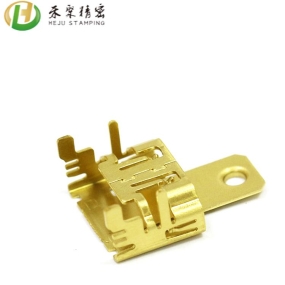
- Electrical connectors.
- Terminal parts.
- Circuit board components.
Copper has good ductility, making it easy to form. However, because it is relatively soft, manufacturers must control tool design carefully to prevent sticking, scratches, or poor surface quality.
How Precision Stamping Plants Select the Right Metal Material
Choosing the correct metal requires more than looking at price. Professional stamping plants usually consider several factors:
- The strength requirements of the final product.
- The complexity of the part shape.
- The required surface quality.
- The working environment of the finished part.
- The expected production quantity and tooling life.
For example, a car safety component may require high-strength steel, while an electronic connector may need copper because electrical performance is more important than strength.
EMAR uses professional experience in material analysis and precision stamping production to help customers select suitable metals for different applications. By understanding material properties before manufacturing, EMAR can improve production stability, reduce defects, and provide high-quality stamped parts.
Conclusion
Understanding metal properties is a basic requirement for successful precision stamping. Strength, ductility, hardness, density, thermal conductivity, and corrosion resistance all influence the stamping process and final product performance.
When precision stamping parts processing plants understand the characteristics of different metals, they can select the right materials, optimize production processes, protect stamping tools, and produce reliable parts for different industries.
Whether using steel, aluminum, copper, or other alloys, professional material selection is the foundation of high-quality precision stamping manufacturing.