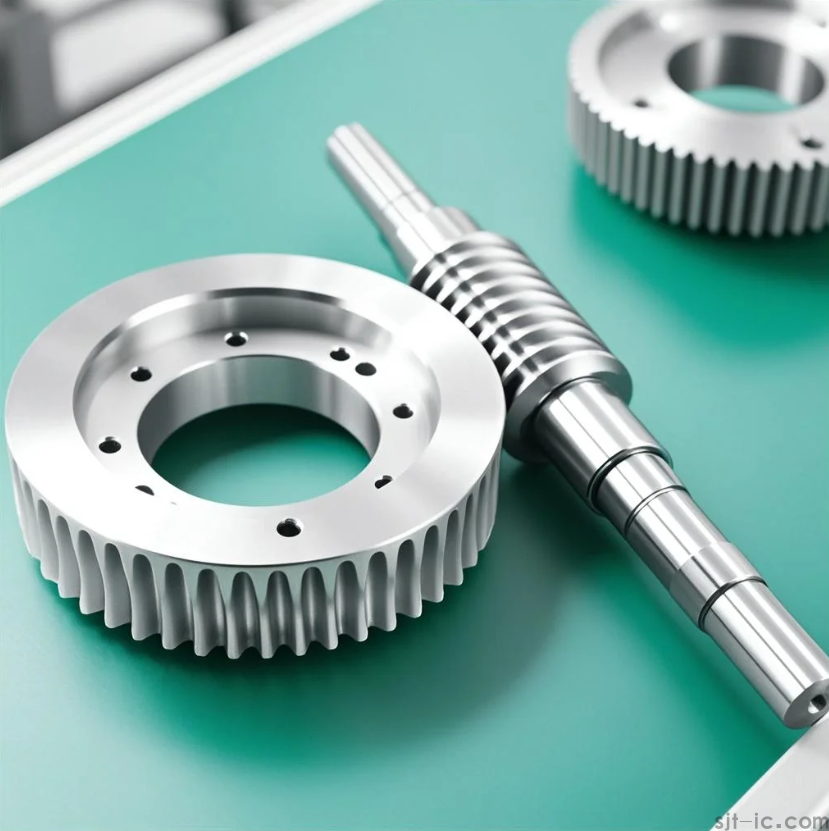
Transmission worm gears are widely used in industrial equipment, automation systems, elevators, conveyors, and mechanical drive systems because they can provide high reduction ratios in a compact space. However, producing reliable worm gears is not easy. Small errors in tooth shape, surface finish, or alignment can cause vibration, noise, overheating, and early wear.
CNC Machining Transmission Worm Gears provides an effective solution for manufacturers that need accurate, durable, and consistent gear components. With advanced CNC equipment, professional machining knowledge, and strict inspection processes, companies such as EMAR help customers produce worm gears that meet demanding performance requirements.
Worm gears require very accurate tooth profiles because the worm and worm wheel must work together with continuous sliding contact. Traditional machining methods may struggle to maintain the required accuracy, especially for complex tooth geometries. CNC machining offers better control over cutting movements and produces stable results during both prototype and production manufacturing.
One of the biggest advantages of CNC machining is high precision in tooth profile manufacturing. Accurate tooth geometry allows the worm gear system to transmit power smoothly, reduce friction, and minimize operating noise. This is especially important for machines that require quiet operation and long service life.
CNC machines can also repeat the same machining process many times with very small differences between parts. This repeatability helps manufacturers maintain consistent quality in batch production and reduces the risk of assembly problems.
A successful worm gear starts with a well-planned design. Before machining begins, engineers must consider the working conditions, required load, operating speed, and expected service life. Proper design reduces manufacturing difficulties and improves the final performance of the gear system.
The gear ratio is one of the most important design factors. It determines how much the output speed is reduced and how much torque is increased. Engineers calculate the relationship between the number of worm starts and the number of worm wheel teeth to achieve the required transmission ratio.
A higher reduction ratio can provide greater torque output, but it may also increase sliding friction and heat generation. The correct balance between speed reduction, efficiency, and operating temperature is essential.
The helix angle affects the contact condition between the worm and worm wheel. A suitable helix angle improves tooth engagement, reduces friction, and helps achieve smoother power transmission.
During design, engineers must match the worm helix angle with the worm wheel tooth direction. Incorrect angles may lead to poor contact, increased wear, and reduced efficiency.
The worm diameter, worm wheel diameter, module, tooth thickness, center distance, and contact area must be carefully calculated. Incorrect dimensional relationships can create uneven load distribution and shorten the service life of the gear set.
Professional manufacturers consider these factors during the CAD design stage and use simulation or engineering analysis when necessary. This approach helps avoid problems before machining starts.
Choosing the correct material is critical because worm gears experience continuous sliding contact, friction, and mechanical loads. The best material depends on the application requirements, including load-bearing capacity, wear resistance, operating environment, and cost.
Material selection for worm gear CNC machining usually involves balancing strength, durability, machining performance, and production cost.
In many worm gear systems, the worm and worm wheel use different materials. For example, a hardened steel worm combined with a bronze worm wheel can provide good strength while reducing friction and wear.
The manufacturing process of worm gears requires several machining operations. Each step affects the final accuracy and performance of the gear.
The first machining step is often turning the worm shaft. CNC lathes are used to create the basic shaft diameter, shoulders, grooves, and mounting areas.
Typical cutting conditions depend on the material and tool type. For alloy steel, manufacturers may use carbide turning tools with spindle speeds around 500–1500 RPM, feed rates of 0.1–0.3 mm/rev, and controlled depths of cut to prevent excessive cutting forces.
Proper tool selection and stable clamping are important to maintain shaft straightness and avoid vibration.
Hobbing operations in worm gear production are essential for creating accurate worm wheel teeth. A CNC hobbing machine uses a rotating cutting tool called a hob to generate the required tooth shape.
The hob and workpiece rotate together according to the designed gear ratio. This synchronized movement creates accurate tooth geometry and ensures proper engagement between the worm and worm wheel.
Typical hobbing parameters include:
For applications requiring higher accuracy, grinding is used after heat treatment. Grinding improves tooth surface quality, reduces roughness, and corrects small machining deviations.
Precision grinding helps achieve better contact between the worm and worm wheel, resulting in lower noise, improved efficiency, and longer operating life.
Handling tooth profile errors in worm gear CNC machining is one of the most important quality challenges. Even small profile deviations can create uneven contact pressure and increase gear noise.
Manufacturers reduce tooth profile errors by using accurate CNC programming, high-quality cutting tools, proper machine calibration, and regular inspection during production.
Machining generates heat, and excessive temperature changes can cause dimensional distortion. This problem is especially important for hardened materials and precision worm gears.
To control thermal effects, manufacturers use proper cutting speeds, cooling fluids, sharp tools, and optimized machining sequences. Leaving proper machining allowance before finishing operations can also help reduce distortion after heat treatment.
Because worm gears have significant sliding contact, lubrication plays an important role in preventing wear. The gear design should consider lubricant type, operating temperature, and load conditions.
Correct lubrication reduces friction, removes heat, and extends the service life of the worm gear system.
After CNC machining, additional treatments can improve mechanical properties and durability.
The correct post-processing method depends on the material, operating environment, and performance requirements of the final application.
Strict inspection is necessary to ensure that worm gears operate correctly after installation. Professional manufacturers apply multiple quality control methods throughout the production process.
Quality control in worm gear CNC manufacturing includes checking dimensions, tooth accuracy, material properties, and surface conditions.
Producing reliable transmission worm gears requires experience in gear design, material selection, CNC programming, machining technology, and inspection methods. A professional supplier can help reduce development risks and improve production efficiency.
EMAR provides CNC machining solutions for precision mechanical parts, including transmission worm gears. With advanced CNC equipment, experienced engineers, and strict quality management, EMAR supports customers from design evaluation to final production. The company focuses on achieving accurate tooth profiles, stable dimensions, and reliable performance for different industrial applications.
For companies looking for dependable worm gear manufacturing, choosing a skilled CNC machining partner can improve product quality, reduce maintenance costs, and ensure long-term transmission performance.