Spanish
 Arabic
 French
 Portuguese
 Belarusian
 Japanese
 Russian
 Malay
Malay Icelandic
 Bulgarian
 Azerbaijani
 Estonian
 Irish
Irish Polish
 Persian
 Boolean
 Danish
 German
 Filipino
 Finnish
 Korean
 Dutch
Dutch Galician
 Catalan
 Czech
Czech Croatian
 Latin
Latin Latvian
 Romanian
 Maltese
 Macedonian
 Norwegian
 Swedish
 Serbian
 Slovak
 Slovenian
 Swahili
 Thai
Thai Turkish
 Welsh
Welsh Urdu
Urdu Ukrainian
 Greek
Greek Hungarian
 Italian
 Yiddish
 Indonesian
 Vietnamese
 Haitian Creole
 Spanish Basque

HTML
Mold CNC Machining Process: A Complete Guide from Design to Quality Control
The Mold CNC Machining Process is a key manufacturing method used to create high-precision molds for industries such as automotive, electronics, medical devices, and consumer products. A well-made mold directly affects the quality, appearance, and production efficiency of the final parts.
Many manufacturers face common challenges during mold production, including poor part accuracy, long machining time, high tool wear, and difficulty achieving smooth surface finishes. CNC machining helps solve these problems by providing precise control, stable production, and the ability to create complex mold structures that are difficult to achieve with traditional machining methods.
Why CNC Machining Is Important for Mold Production
Molds require extremely high accuracy because they are used to replicate thousands or even millions of parts. Small errors in the mold can cause defects in every produced component. CNC machines use computer-controlled programs to achieve consistent dimensions and repeatable results.
The main advantages of CNC machining for molds include:
- High precision: CNC machines can produce tight tolerances, helping molds create parts with accurate dimensions and proper fitting.
- Complex shape production: Multi-axis CNC machining can manufacture curved surfaces, deep cavities, fine details, and complicated geometries.
- Efficient production: Automated machining reduces manual operations, shortens production time, and improves consistency.
- Better repeatability: The same CNC program can produce multiple molds with similar quality.
For manufacturers that need reliable mold production, choosing an experienced CNC machining partner is important. Companies like EMAR use advanced CNC equipment and professional machining experience to support mold development from prototype production to large-scale manufacturing.
Design Considerations in Mold CNC Machining
The success of a mold starts with careful design. Before machining begins, engineers analyze the product requirements and create a mold structure that can produce accurate parts while allowing efficient manufacturing.
Part Geometry Analysis
The shape and size of the final product directly influence mold design. Engineers consider wall thickness, sharp corners, deep cavities, draft angles, and surface details. A good design reduces machining difficulty and helps prevent problems such as incomplete filling or part deformation.
Ejection System Design
The ejection system allows the finished part to be removed from the mold safely. Incorrect ejector pin locations or insufficient ejection force can damage the part or reduce mold life. Engineers carefully plan ejector pins, slides, and other mechanisms according to the product structure.
Cooling Channel Layout
Cooling channels control mold temperature during production. Proper cooling channel design improves cycle time, prevents uneven shrinkage, and increases part quality. Engineers must balance cooling efficiency with machining difficulty when designing channel locations.
These design considerations in mold CNC machining help manufacturers reduce production risks and create molds with better performance and longer service life.
Material Selection for Mold CNC Production
The choice of mold material affects durability, machining performance, heat resistance, and maintenance requirements. Different applications require different material properties.
Important factors in material selection for mold CNC production include:
- Durability: The material must resist wear during repeated production cycles.
- Heat resistance: Molds used for high-temperature processes need materials that maintain strength under heat.
- Machinability: Materials should allow efficient cutting while maintaining accuracy.
- Corrosion resistance: Some molds require protection against moisture, chemicals, or harsh production environments.
Common mold materials include:
- P20 steel: A popular mold steel with good machinability and balanced strength for many plastic injection molds.
- H13 steel: Known for excellent heat resistance and commonly used for high-temperature applications.
- Stainless steel: Provides corrosion resistance and is suitable for demanding environments.
- Aluminum alloys: Lightweight materials that are easy to machine and suitable for prototypes or low-volume production.
Selecting the correct material helps control costs while ensuring the mold meets performance requirements.
Main Steps in the Mold CNC Machining Process
1. Mold Programming and Preparation
After the mold design is completed, engineers create CNC programs based on the 3D model. CAM software is used to plan tool paths, cutting directions, and machining sequences. Proper programming reduces machining errors and improves efficiency.
2. Rough Machining in Mold CNC Process
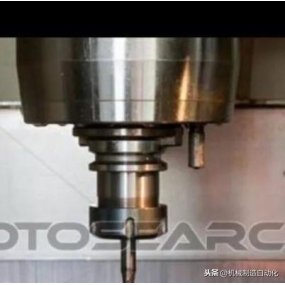
Rough machining in mold CNC process is the first cutting stage. The goal is to remove large amounts of material quickly and create the basic mold shape.
During rough machining, manufacturers select strong cutting tools and suitable cutting parameters:
- Cutting speed: Controls how fast the tool rotates or moves through the material.
- Feed rate: Determines how quickly the cutting tool advances.
- Depth of cut: Controls how much material is removed in each pass.
For rough machining, a larger depth of cut and higher material removal rate are often used. However, cutting conditions must be carefully controlled to avoid excessive vibration and tool damage.
3. Semi-Finishing Machining
Semi-finishing removes remaining material after rough machining and prepares the mold surface for final machining. This step improves dimensional accuracy and creates a more stable surface condition for finishing operations.
4. Finishing Machining
Finishing focuses on achieving final dimensions and smooth surfaces. Smaller cutting tools are often used to machine fine details, corners, and curved surfaces.
Proper tool selection is important during finishing. Ball end mills are commonly used for complex curved surfaces, while smaller diameter tools help produce detailed features.
Challenges During Mold CNC Machining and Solutions
Handling Heat Generation in Mold CNC Machining
Handling heat generation in mold CNC machining is important because excessive heat can reduce tool life, affect dimensional accuracy, and damage the mold surface.
Manufacturers manage heat problems through:
- Using suitable cutting speeds and feed rates.
- Applying proper coolant methods.
- Selecting heat-resistant cutting tools.
- Optimizing tool paths to reduce unnecessary cutting load.
Reducing Tool Wear
Tool wear is a common issue when machining hard mold materials. Worn tools can create inaccurate dimensions and poor surface quality. Regular tool inspection, proper tool coatings, and optimized cutting conditions help extend tool life.
Achieving Smooth Surface Finish
A smooth mold surface reduces polishing work and improves the appearance of molded parts. Manufacturers achieve better finishes by using high-quality tools, stable machine settings, and precise finishing strategies.
Post-Machining Processes for Mold Improvement
Heat Treatment
Heat treatment improves mold hardness, strength, and wear resistance. Processes such as hardening and tempering help molds withstand repeated production cycles.
Surface Treatment
Surface treatments improve mold performance by increasing corrosion resistance and reducing friction. Common methods include coating, polishing, and surface hardening.
The right post-machining process depends on the mold material, production environment, and expected service life.
Quality Control in Mold CNC Manufacturing
Quality control in mold CNC manufacturing ensures that every mold meets design specifications before it enters production. A professional inspection process helps prevent expensive production problems.
Important quality control methods include:
- Dimensional inspection: Measuring mold features with precision instruments to confirm accuracy.
- Surface inspection: Checking surface roughness and appearance.
- Coordinate measuring machine (CMM) inspection: Verifying complex mold geometries and tight tolerances.
- Trial production testing: Testing the mold with actual production conditions to identify possible issues.
Experienced CNC machining manufacturers such as EMAR combine advanced equipment, skilled engineers, and strict inspection procedures to provide reliable mold machining solutions for different industries.
How to Choose a Reliable Mold CNC Machining Partner
A good mold machining supplier should have strong technical capabilities, modern CNC equipment, quality management systems, and experience with different mold materials and applications.
Before selecting a supplier, customers should consider:
- Experience in complex mold machining projects.
- Ability to handle prototype and production requirements.
- Advanced CNC milling and multi-axis machining capabilities.
- Strict quality inspection procedures.
- Support from design improvement to final production.
The Mold CNC Machining Process requires a combination of accurate design, suitable materials, advanced machining technology, and careful quality control. By working with an experienced manufacturer, companies can achieve molds with higher accuracy, longer service life, and better production efficiency.