Spanish
 Arabic
 French
 Portuguese
 Belarusian
 Japanese
 Russian
 Malay
Malay Icelandic
 Bulgarian
 Azerbaijani
 Estonian
 Irish
Irish Polish
 Persian
 Boolean
 Danish
 German
 Filipino
 Finnish
 Korean
 Dutch
Dutch Galician
 Catalan
 Czech
Czech Croatian
 Latin
Latin Latvian
 Romanian
 Maltese
 Macedonian
 Norwegian
 Swedish
 Serbian
 Slovak
 Slovenian
 Swahili
 Thai
Thai Turkish
 Welsh
Welsh Urdu
Urdu Ukrainian
 Greek
Greek Hungarian
 Italian
 Yiddish
 Indonesian
 Vietnamese
 Haitian Creole
 Spanish Basque

Machining precision stamping parts has strict requirements on the thickness of the sheet metal, because the thickness of the material determines the gap of the mold. The thickness of the sheet metal varies greatly, and the production with the same stamping die and the same gap will affect the quality and accuracy of the product. Severe mold damage will occur, and even equipment accidents will occur when producing large precision stamping parts. What is the impact of excessive thickness of the sheet metal?
1. In the blanking process, burrs can be formed if the positive error of sheet thickness is too large or the negative error is too large. Sheets with too large negative error increase springback and affect scale accuracy. Sheets with too large positive error increase punching force and punching work, which may damage stamping equipment. Uneven material thickness can also make stamping parts appear unilateral burrs.
2. In the zigzag process, the material with large negative errors rebounds, forming inaccurate shapes and dimensions of precision stamping parts, and easy to form deflection and bending phenomena. If the positive error of material thickness is too large, the zigzag surface kneading will be formed, which will affect the surface quality of the stamping parts and increase the zigzag force and zigzag work, which may damage the equipment. Uneven thickness will also form inaccurate shapes and scales of stamping parts. 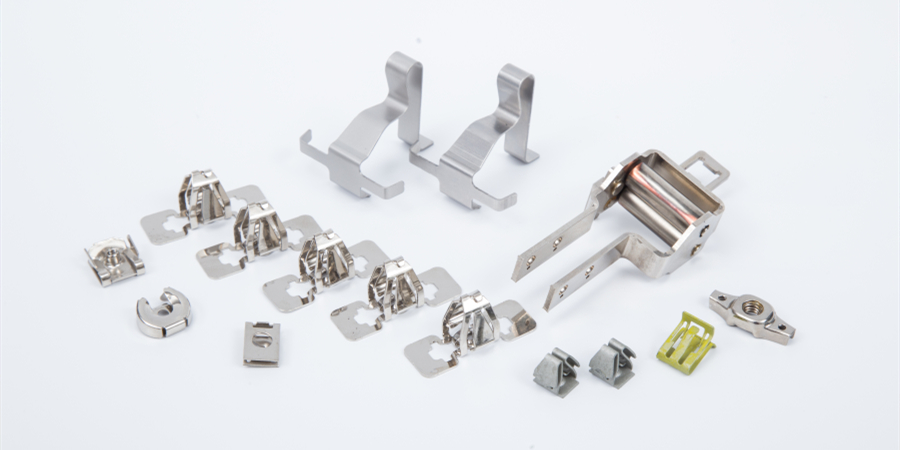
3. In the deep drawing process, the negative error of material thickness is too large, which will cause uneven shape due to springback, and will also form a lack of height of precision stamping parts and a small phenomenon of large bottom of stamping parts, which will also reduce the pressing force. In addition, the relative increase in the gap between convex and concave molds causes the material to wrinkle during the drawing process, which increases the difficulty of metal material activity, thereby increasing the drawing force, resulting in cracking of stamping parts at the rounded corners of the concave mold. The positive error of material thickness is too large, which increases the friction between the material and the blank holder ring and the mold, and the relative decrease in the gap between convex and concave molds increases the drawing force, forming a thinning of the material and a cracking phenomenon at the rounded corners of the punch. And because of the increase of the drawing force and the drawing work, it may become an equipment overload. Uneven material thickness will cause uneven wall thickness of the stamping part and uneven edge of the mouth. Severe uneven material thickness will cause cracking of the stamping part, and damage the die and equipment for large stamping parts.
This article is from EMAR Mold Co., Ltd. For more EMAR related information, please click: www.sjt-ic.com!