How to Produce from Numerical Control Machine Tools to Mechanical Parts
Modern manufacturing depends on accurate and efficient production methods. Many industries use numerical control (NC) machine tools to transform digital designs into high-quality mechanical parts. Understanding How to Produce from Numerical Control Machine Tools to Mechanical Parts helps engineers, buyers, and manufacturers control quality, reduce costs, and improve production efficiency.
The complete production process includes several important steps, from design preparation and material selection to machining operations and quality inspection. A professional manufacturer such as EMAR uses advanced NC machining technology and strict production management to produce reliable mechanical parts for different industrial applications.
1. Design Preparation for NC Mechanical Parts Production
Understanding Product Requirements and Applications
The production process starts with a clear understanding of the mechanical part’s purpose. Before machining begins, engineers need to collect important requirements, including part function, load-bearing capacity, working environment, temperature conditions, and expected service life.
For example, an automotive engine component must withstand high temperatures, vibration, and continuous mechanical stress. A part used in industrial equipment may require high strength, wear resistance, or corrosion resistance. Understanding these requirements helps engineers create a suitable design and avoid problems during later production stages.
CAD Design for Accurate Part Development
After collecting product requirements, designers create the part model using Computer-Aided Design (CAD) software. CAD technology is an essential part of design for NC-produced mechanical parts because it allows engineers to create accurate 2D drawings and 3D models before machining.
A CAD model includes important information such as:
- Part dimensions and geometric features
- Required tolerances for precision areas
- Surface finish requirements
- Assembly positions and connection details
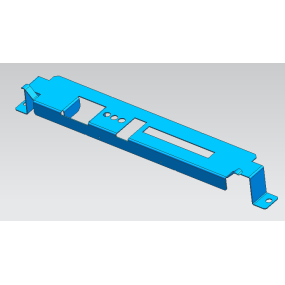
For example, when designing a simple mounting bracket, engineers can create the basic shape in CAD, add holes for bolts, define thickness requirements, and check different views to confirm that the design meets assembly needs. If changes are required, the CAD model can be quickly modified without rebuilding the entire design.
CAM Programming for NC Machine Instructions
Once the CAD design is completed, engineers use Computer-Aided Manufacturing (CAM) software to create machining programs. CAM converts the digital model into instructions that NC machine tools can understand.
The CAM program defines important machining information, including:
- Cutting tool selection
- Tool movement paths
- Cutting speed
- Feed rate
- Cutting depth
Proper CAM programming improves machining accuracy and reduces unnecessary cutting movements. This helps manufacturers produce complex mechanical parts faster while maintaining stable quality.
2. Material Selection for NC Machined Mechanical Parts
Choosing Materials Based on Mechanical Requirements
Material selection is one of the most important decisions in the production process. Different mechanical parts require different material properties. Engineers must consider strength, hardness, weight, corrosion resistance, and operating conditions.
Common material choices include:
- Alloy steel: Suitable for high-strength parts that need excellent load resistance.
- Aluminum alloy: A good choice when lightweight design and corrosion resistance are important.
- Titanium alloy: Used for applications requiring high strength with low weight.
- Carbon steel: A cost-effective option for general mechanical applications.
The correct material selection in NC-machining ensures that the final part can perform reliably in its working environment.
Balancing Performance and Material Cost
High-performance materials usually have higher costs. Therefore, manufacturers need to balance technical requirements and budget limitations. Choosing the most expensive material is not always the best solution.
For example, if a mechanical component does not require extreme strength or heat resistance, carbon steel may provide enough performance at a lower cost compared with high-alloy steel. Proper engineering analysis can reduce material expenses while maintaining product quality.
Material Compatibility with Machining Processes
Different materials behave differently during machining. Some materials are easy to cut, while others require special tools and machining methods.
For example, stainless steel provides excellent corrosion resistance but can create more tool wear compared with mild steel. Manufacturers must select suitable cutting tools, speeds, and cooling methods to achieve good machining results.
3. Machining Operations on NC Machine Tools for Parts
Milling Operations
Milling is one of the most common machining processes used in NC manufacturing. During milling, rotating cutting tools remove material from a workpiece to create different shapes and features.
Milling can produce:
- Flat surfaces
- Slots and grooves
- Pockets
- Complex 3D shapes
Different milling cutters are selected according to the required geometry:
- End mills: Used for general cutting, slots, and pockets.
- Ball-nose mills: Suitable for curved surfaces and 3D machining.
- Face mills: Used for creating large flat surfaces.
Cutting parameters must be optimized according to the material. For example, aluminum usually allows higher cutting speeds, while harder materials require slower speeds and more careful tool selection. Proper control of cutting speed, feed rate, and depth of cut improves efficiency and tool life.
Turning Operations
Turning is mainly used for producing cylindrical mechanical parts. In an NC lathe, the workpiece rotates while a cutting tool removes material to achieve the required diameter, length, and surface quality.
Turning is commonly used for producing:
- Shafts
- Pins
- Rotating components
- Cylindrical connectors
The cutting tool selection depends on the workpiece material. Hard materials may require stronger cutting inserts, while softer materials can use different tool geometries for faster production.
Drilling and Boring Processes
Drilling creates holes in mechanical parts, while boring improves the accuracy and size of existing holes. These operations are important because many components require precise holes for bolts, shafts, and pins.
Correct drill selection depends on material type, hole diameter, and production requirements. Maintaining hole straightness and dimensional accuracy prevents assembly problems and improves the reliability of the final product.
4. Quality Control in NC Made Mechanical Parts
In-Process Inspection During Machining
Quality control is necessary throughout the machining process, not only after production is finished. In-process inspection helps detect problems early and prevents defective parts from continuing through production.
Manufacturers use precision measurement equipment such as:
- Calipers for general dimension checks
- Micrometers for high-precision measurements
- Coordinate Measuring Machines (CMMs) for complex geometries
For example, if a machined hole is found to be slightly outside the required tolerance during inspection, engineers can correct the machining process immediately. This prevents additional processing of defective parts and reduces material waste.
Final Product Testing
After machining is completed, final inspection verifies that the mechanical part meets customer requirements. Testing may include:
- Hardness testing to confirm material properties
- Surface finish inspection to check smoothness
- Dimensional inspection to confirm accuracy
- Functional testing to verify performance
Following industry standards and customer specifications ensures that NC-produced mechanical parts can work safely and reliably in real applications. Companies like EMAR apply strict quality control systems to help customers receive consistent and dependable machined components.
5. Cost-Effectiveness in NC Part Production
Optimizing Machining Parameters
Machining efficiency directly affects production cost. Proper adjustment of cutting speed, feed rate, and cutting depth can reduce machining time while extending tool life.
If cutting parameters are too aggressive, tools may break faster and increase replacement costs. If parameters are too conservative, production becomes slower and more expensive. Finding the right balance helps achieve efficient production.
Managing Production Volume and Manufacturing Costs
Production quantity also affects the cost of mechanical parts. Large-volume production usually reduces the cost per unit because setup costs and programming expenses are distributed across more parts.
For small-batch production, manufacturers can reduce costs through efficient programming, flexible NC equipment, and optimized production planning. Experienced suppliers can help customers choose the most economical production method according to their project needs.
Reducing Scrap and Rework Costs
Scrap and rework create unnecessary expenses. Effective quality control, accurate programming, and proper machining processes help reduce production errors.
By identifying problems early, manufacturers can avoid wasting materials, machine time, and labor. This improves overall cost-effectiveness in NC part production and provides better value for customers.
Conclusion: Building Reliable Mechanical Parts Through NC Machining
The journey from numerical control machine tools to finished mechanical parts requires careful planning, accurate design, suitable material selection, professional machining operations, and strict quality control.
Understanding each production step helps businesses make better decisions when developing new components. With advanced NC machining equipment, skilled engineers, and quality management systems, manufacturers such as EMAR can provide customized mechanical parts that meet different industrial requirements.
Whether for automotive, aerospace, electronics, or industrial equipment applications, a well-managed NC machining process creates parts with high precision, reliable performance, and competitive production costs.