Spanish
 Arabic
 French
 Portuguese
 Belarusian
 Japanese
 Russian
 Malay
Malay Icelandic
 Bulgarian
 Azerbaijani
 Estonian
 Irish
Irish Polish
 Persian
 Boolean
 Danish
 German
 Filipino
 Finnish
 Korean
 Dutch
Dutch Galician
 Catalan
 Czech
Czech Croatian
 Latin
Latin Latvian
 Romanian
 Maltese
 Macedonian
 Norwegian
 Swedish
 Serbian
 Slovak
 Slovenian
 Swahili
 Thai
Thai Turkish
 Welsh
Welsh Urdu
Urdu Ukrainian
 Greek
Greek Hungarian
 Italian
 Yiddish
 Indonesian
 Vietnamese
 Haitian Creole
 Spanish Basque

In the rapidly evolving world of modern manufacturing, precision and efficiency are paramount. As industries demand increasingly complex geometries, the limitations of traditional machining processes become apparent. While 3-axis CNC machines have been the industry workhorse for decades, the leap to 4-axis CNC Machining opens up a new realm of possibilities.
This comprehensive guide will explore what 4-axis machining is, how it works, its distinct advantages over 3-axis systems, and why it might be the perfect solution for your next project with EMAR.
What is CNC Machining?
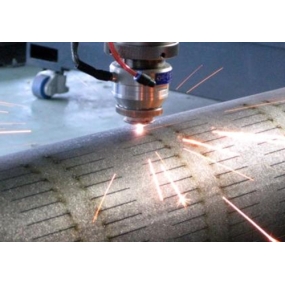
Computer Numerical Control (CNC) machining is a subtractive manufacturing process where pre-programmed software dictates the movement of factory machinery and tools. This allows for the precise, automated creation of parts from various materials, including metal, plastic, wood, and composites. While a standard setup offers significant capabilities, the complexity of the part dictates the level of machinery required.
What is a 4-Axis CNC Machine?
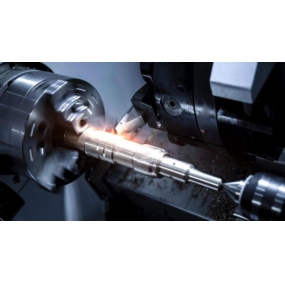
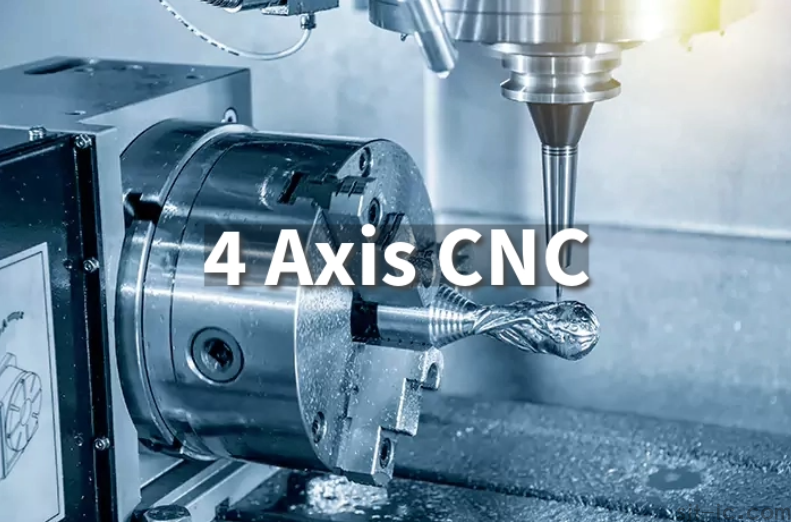
A 4-axis CNC machine is a machining center that operates on four axes of movement simultaneously. It includes the three standard linear axes—X (left/right), Y (front/back), and Z (up/down) —plus an additional rotary axis.
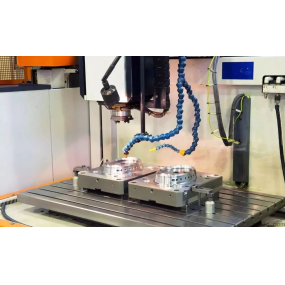
This fourth axis, typically referred to as the A-axis, rotates around the X-axis. This rotation is usually facilitated by a rotary table or a trunnion table, to which the workpiece is clamped. By adding this rotational movement, the machine can present different sides of the part to the cutting tool without requiring manual repositioning.
There are two primary modes of operation for a 4-axis machine:
Indexing 4-Axis Machining: In this mode, the rotary axis turns only when the machine is not cutting. Once the part is rotated to the correct position, a brake locks the axis, and machining resumes. This is ideal for machining features on multiple faces of a part.
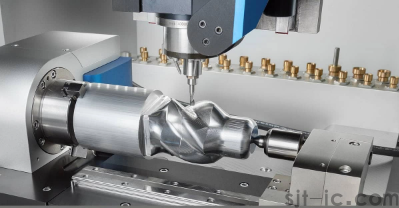
Continuous 4-Axis Machining: Here, the machine cuts the material while the A-axis rotates simultaneously. This allows for the creation of complex arcs, helical paths, and contours, such as those found in cam lobes or turbine blades.
4-Axis vs. 3-Axis: Understanding the Difference
The primary difference between 3-axis and 4-axis machining lies in the complexity of motion and the resulting part geometry.
3-Axis Machining: This is the simplest form of CNC milling. The workpiece is fixed in one position, and the cutting tool moves along the X, Y, and Z linear axes. While highly effective for creating 2D and 2.5D profiles, drilling, and tapping, it has significant limitations. To machine a different side of the part, an operator must manually stop the machine, unclamp the workpiece, and reset it in a new fixture. This increases setup time, labor costs, and the potential for human error.
4-Axis Machining: By adding the A-axis, a 4-axis machine allows the workpiece to rotate. This means multiple sides of a part can be accessed and machined in a single setup. Features that are angled or require radial machining—impossible on a standard 3-axis machine—become achievable.
The Advantages of 4-Axis CNC Machining
Upgrading to or utilizing a 4-axis CNC machine offers several tangible benefits over traditional 3-axis methods:
1. Increased Efficiency and Reduced Setup Times
The most significant advantage is the ability to machine multiple faces of a part in one operation. By eliminating the need for multiple manual re-clamping and re-fixturing steps, you drastically reduce non-cutting time. As EMAR's machining experts note, a part requiring two or three unique (and expensive) fixtures on a 3-axis machine can often be completed with just one fixture on a 4-axis machine, saving both time and money.
2. Handling Complex Geometries
4-axis machining excels at producing parts with intricate designs. Features like angled holes, curved surfaces, and complex profiles (e.g., turbine blades, impellers, and camshafts) can be manufactured with high precision. It allows for the machining of "angled features" (features at an angle to one axis) and, in some cases, "compound angle features" (features at an angle to two axes) that are impossible on a 3-axis machine.
3. Enhanced Accuracy and Consistency
Every time a part is moved to a new fixture, there is a risk of misalignment, which compromises accuracy. By keeping the part on a single rotary table, you maintain a consistent reference point (datum) throughout the process. This ensures tighter tolerances between features on different sides of the part and eliminates errors introduced by multiple setups.
4. Improved Surface Finishes
Continuous 4-axis machining allows for smoother toolpaths. A clever technique called "Sturz Milling" involves tilting the workpiece slightly so that a ballnose cutter engages the material with its side rather than its slow-moving tip. This results in faster feed rates, a better surface finish, and extended tool life.
5. Ability to Machine More Parts Per Cycle
With the use of a "tombstone" fixture—a multi-sided block mounted on the 4th axis—you can dramatically increase the number of parts machined in a single cycle. Parts can be mounted on all sides of the tombstone, effectively increasing your machine's working area and allowing it to run unattended for longer periods.
Key Applications and Industries
The precision and flexibility of 4-axis machining make it indispensable across a wide range of industries. EMAR provides full-service CNC machining for sectors requiring high-performance components, including:
Aerospace: Manufacturing complex parts like turbine blades, engine components, and landing gear parts that require machining on multiple planes.
Medical: Creating intricate surgical tools, orthopedic implants (knees, hips), and prosthetics with customized anatomical fits.
Automotive: Producing engine blocks, cylinder heads, transmission components, shafts, and fuel injection parts.
Oil & Gas: Machining durable valves, hydraulic actuators, and other components that must withstand extreme conditions.
Defense & Military: Fabricating reliable, performance-built components for various defense applications.
General Industrial: Producing high-precision gears, bearings, solenoids, and custom prototypes.
Workholding and Fixturing for 4-Axis Success
Effective workholding is crucial for 4-axis machining. Common methods include:
Lathe Chucks: 3-jaw, 4-jaw, or collet chucks are excellent for holding round or hexagonal stock.
4th Axis Vises: Standard milling vises can be mounted to the rotary table for easy fixturing of prismatic parts.
Tombstones: As mentioned, these are multi-sided fixture plates that maximize part quantity and allow access to multiple sides.
Custom Fixtures: For complex or oddly shaped parts, custom fixtures with quick-change systems (like Jergens Ball Locks) can drastically speed up setup times.
4-Axis CNC Machining Services at EMAR
At EMAR, we understand that every project has unique requirements. We leverage advanced 4-axis vertical CNC machining centers to deliver high-precision parts that meet the most demanding specifications. Our capabilities include:
Advanced Machinery: Our fleet includes high-performance models like the MAZAK NEXUS 510C and NXV series, allowing us to handle a wide range of part sizes and complexities.
Unmatched Precision: Our CNC mills hold critical dimensions and extremely tight tolerances, ensuring your exact specifications are met.
Quality Assurance: With over 20 years of experience, ISO 9001 Certified processes, and advanced CMM measuring technology, we guarantee accurate, high-quality components.
Versatility: From prototyping to mass production, we can tailor our services to match your volume needs. We work with a vast array of materials, from aluminum and steel to exotic alloys and plastics.
Expert Programming: Our innovative programming software and experienced machinists ensure efficient toolpaths and flawless execution, whether for indexing or continuous 4-axis work.
Conclusion
4-axis CNC machining represents a significant advancement over 3-axis technology, offering unparalleled efficiency, accuracy, and the ability to produce highly complex parts. By reducing setup times and enabling more intricate designs, it empowers manufacturers to push the boundaries of innovation.
If your project requires complex geometries, multi-sided machining, or simply a more efficient production process, EMAR has the expertise and technology to bring your design to life.
Ready to start your next project?
Contact EMAR today to discuss your specific needs. Our team of manufacturing specialists is ready to help you maximize the performance of your CNC processes.
Email: sales8@sjt-ic.com
Phone: +86 18664342076
Let us help you navigate the complexities of advanced manufacturing and deliver precision-engineered components that exceed your expectations.