
Running high-precision plastic parts CNC machining looks easy on paper—no hard alloy chatter, zero premature insert chipping, and fast tool movement.
Then you clamp a block of POM-C, run your program, and watch a tight-tolerance bore shrink by 0.05 mm the moment you drop it out of the vise. Or worse—your expensive high-purity PEEK stock turns into a smeared, melted ball around your end mill.
Plastics don't behave like metal. They have poor thermal conductivity and high thermal expansion rates. If you treat custom plastic parts CNC machining like aluminum or steel milling, you’re bound to scrap parts.
Having spent over a decade on our shop floor machining complex polymer components for medical devices and aerospace optical housings, here is our battle-tested playbook for cutting engineering plastics with strict accuracy every single run.
Standard 4-flute carbide end mills designed for steel will ruin plastic fast. Polymers are natural insulators; heat generated during cutting doesn't escape through chips like it does with copper or aluminum. It stays localized right at the shear zone, triggering immediate melt-back.
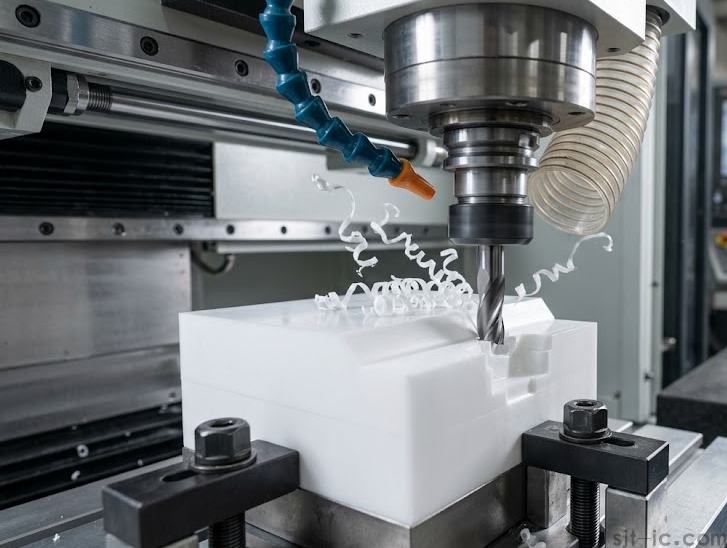
For reliable CNC machining of plastic parts, tool geometry must focus on instant chip clearance:
Flute Count: Stick strictly to 1-flute or 2-flute router bits or specialized plastic cutters.
Rake & Relief Angles: High positive rake angles shear material cleanly instead of pushing it. Ensure generous primary relief so the heel doesn't drag against part walls—because tool rub causes heat, and heat ruins dimensions.
Edge Sharpness: Never use a tool that previously cut metal. Even minor microscopic wear will tear soft plastics like UHMW-PE, causing heavy burrs.
Flood coolant isn't a universal fix for plastic machining. Certain water-soluble cutting oils cause micro-stress cracking on Polycarbonate, while Nylon absorbs moisture, swelling off-spec within hours.
Cold Air Blast: Hooking a cold-air gun straight to your spindle clears chips instantly without chemical contamination—ideal for cleanroom medical parts.
MQL Systems: Minimum Quantity Lubrication works well for soft PVC or Teflon to prevent built-up edge (BUE).
AI-Adaptive Feed Control: Modern CNC controllers monitor micro-load spikes on the spindle in real time. If material resistance shifts, feed rates auto-adjust instantly to keep cutting temperatures well below the polymer's glass transition threshold.
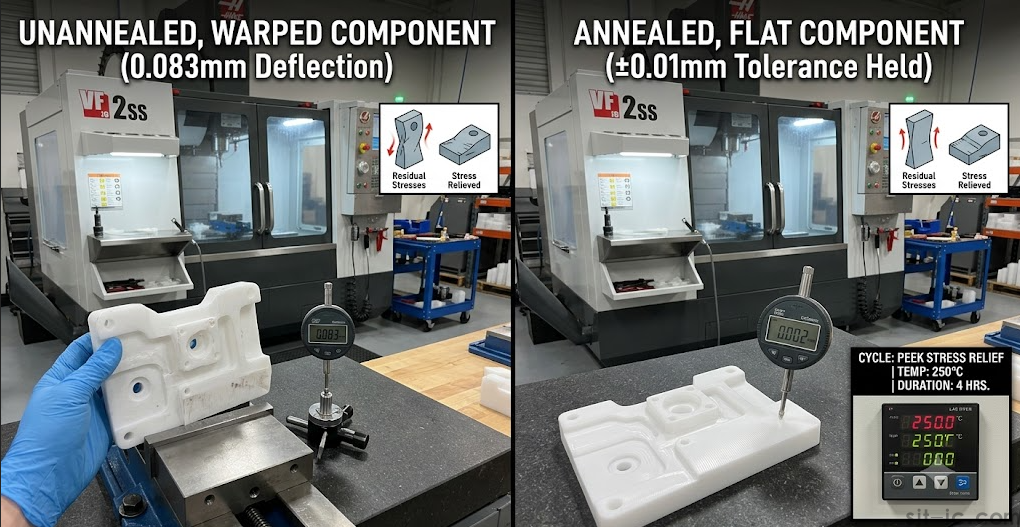
Aerospace and defense programs increasingly demand high-performance thermoplastics like PEEK, Torlon, and ULTEM. However, extruded stock carries internal manufacturing stresses. Hogging out 70% of material in one heavy pass practically guarantees your flat plate warps into a potato chip overnight.
To hold ±0.01 mm tolerances on complex plastic parts CNC machining projects, we use this 4-step protocol:
Rough Milling: Leave 1.0 mm to 1.5 mm of stock across all critical surfaces.
Thermal Stress Relieving: Run parts through a controlled oven cycle (annealing) to release tension before finishing.
Finish Machining: Execute light, rapid finish passes using razor-sharp diamond-coated (CVD) or PCD tooling.
Low-Distortion Fixturing: Avoid aggressive vise pressure. Use soft jaws mapped to part contours or vacuum chucks to hold slim parts flat without crushing them.
High RPM with overly conservative feed rates doesn't yield a mirror finish; it rubs the polymer until it friction-welds. Keep your chip load per tooth high enough so the cutting edge slices beneath the material instead of wiping across it.
Acetal / POM-C: Feeds smoothly and breaks chips easily. Ideal for rapid prototyping, though thick stock requires checking for centerline porosity.
PEEK / ULTEM: Abrasive on standard carbide edges. Always use PCD tooling for long-run production to maintain edge sharpiness.
UHMW-PE: Famous for producing long stringy ribbons (long-chipping). Use aggressive feeds paired with custom chip breakers to prevent bird-nesting around your spindle.
A: On standard polymers like Acetal or Nylon, we routinely hold ±0.025 mm (0.001"). For high-stability materials like stress-relieved PEEK or Torlon under climate-controlled shop conditions, we achieve tolerances down to ±0.01 mm.
A: Warping occurs due to residual internal stresses within extruded plastic stock combined with heat buildup during milling. Performing rough machining followed by an oven annealing cycle before final finishing eliminates post-clamping distortion.
A: Yes. Medical-grade polymers like PEEK-OPTIMA or USP Class VI Polycarbonate are machined using dry cold-air cooling or USP-compliant lubricants to guarantee zero oil contamination.
Mastering plastic parts CNC machining isn't about running machines faster—it’s about managing material memory, controlling heat at the tool edge, and selecting the right fixturing strategy.
If you have a challenging drawing or need a quick sanity check on a tight-tolerance plastic print, our engineering team is here to help. [Contact us today or upload your CAD files] for a free manufacturability review and fast quote.