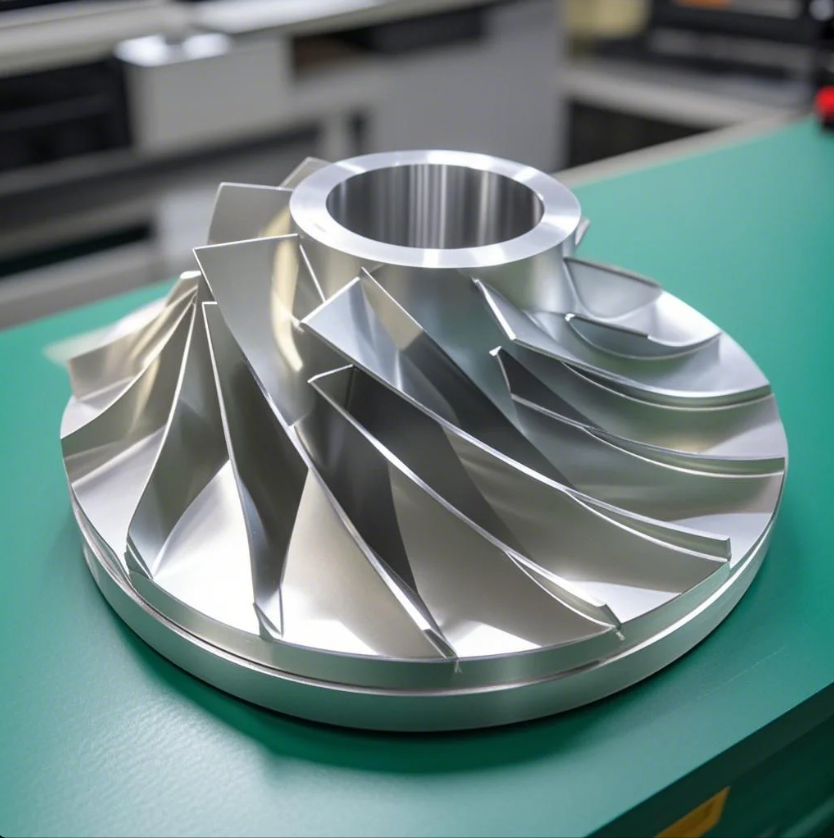
Impellers are critical components used in pumps, compressors, and fluid handling systems. Their performance directly affects fluid flow efficiency, pressure output, and energy consumption. Because impellers have complex curved blades and strict accuracy requirements, traditional machining methods often cannot meet modern production needs. CNC Impeller Machining provides an effective solution by using advanced computer-controlled equipment to produce precise, reliable, and high-performance impeller parts.
Many manufacturers face challenges when producing impellers, including controlling dimensional accuracy, machining complicated blade shapes, reducing production costs, and maintaining consistent quality. CNC Machining helps solve these problems by combining precise tool movement, advanced programming, and flexible multi-axis processing capabilities.
An impeller must have an accurate blade profile to guide fluid smoothly. Even small errors in blade angles, thickness, or surface shape can reduce pump efficiency, increase vibration, and create unwanted energy loss. CNC machining can achieve the tight tolerances needed for efficient fluid movement and stable operation.
Unlike conventional machining methods, CNC equipment can follow complex 3D tool paths. This makes it possible to manufacture impellers with curved blades, narrow channels, and unique geometries that are difficult to produce manually. Multi-axis CNC machines can access different areas of the part without frequent repositioning, improving both accuracy and production efficiency.
For companies requiring reliable impeller production, experienced CNC manufacturers such as EMAR provide professional machining solutions, including precision programming, material processing, and quality inspection to support different industrial applications.
The design stage has a major impact on the performance and manufacturability of an impeller. Design considerations for CNC-machined impellers should include operating conditions, fluid characteristics, material requirements, and machining limitations.
A well-planned design can reduce machining time, prevent unnecessary material waste, and improve the final performance of the impeller.
Choosing the correct material is essential because impellers often operate under high loads, pressure changes, and corrosive environments. Material selection for impeller CNC machining depends on strength, weight, corrosion resistance, temperature conditions, and operating environment.
The selected material also affects machining parameters, tool wear, and production cost. Experienced CNC machining providers can recommend suitable materials based on the working conditions and performance requirements of the impeller.
Producing an impeller requires several machining processes. The exact operation sequence depends on the design complexity, material, and required accuracy.
Multi-axis milling is one of the most important processes in CNC impeller machining. It allows cutting tools to move along multiple directions, making it possible to create complex blade surfaces and internal flow channels.
For impellers with advanced blade designs, 5-axis CNC machining is commonly used because it improves surface accuracy, reduces setup time, and allows better control of tool angles.
Turning operations are used to create round features such as shafts, hubs, and rotational surfaces. Accurate turning helps ensure proper assembly and balance between the impeller and other machine components.
Grinding is often used after milling to improve dimensional accuracy and surface quality. It helps achieve smoother surfaces where precise contact or low friction is required.
CNC impeller machining requires carefully selected cutting tools and machining parameters. Incorrect settings may cause tool wear, vibration, poor surface quality, or dimensional errors.
Professional CNC programmers optimize these factors based on material, machine capability, and impeller geometry to achieve stable production and control costs.
Impeller blades often have free-form curved surfaces that are difficult to machine. Advanced CNC programming and multi-axis machining help accurately reproduce these complex shapes while maintaining design requirements.
Handling surface finish in impeller CNC machining is important because rough surfaces increase fluid friction and reduce efficiency. Proper tool selection, optimized cutting conditions, and finishing processes help create smooth blade surfaces for better fluid flow.
Vibration can affect accuracy and damage surface quality, especially when machining thin blades. Using rigid fixtures, balanced cutting tools, and optimized machining strategies helps maintain precision.
CNC machining may require advanced equipment and programming, but it reduces long-term costs through repeatable production, lower error rates, and reduced manual labor. Proper design optimization and efficient machining planning can further improve cost-effectiveness.
After machining, additional treatments may be required to improve durability and performance. Post-machining processes for CNC-machined impellers help enhance mechanical properties and protect the part during operation.
Strict inspection is necessary to ensure every impeller meets performance requirements. Quality control in CNC-machined impellers includes dimensional inspection, surface analysis, and functional testing.
Reliable quality control reduces the risk of failure and ensures consistent performance in real operating environments.
Successful impeller manufacturing requires more than advanced CNC equipment. It requires experience in design analysis, material selection, machining strategy, and quality management. A skilled machining partner can help optimize designs, select suitable materials, and create efficient production processes.
EMAR focuses on precision CNC machining solutions and supports customers with professional CNC impeller machining services. With experience in complex part manufacturing, advanced machining technology, and strict quality control methods, EMAR helps industries produce accurate and reliable impeller components for demanding applications.
CNC Impeller Machining is essential for producing high-performance impellers with complex geometries and strict accuracy requirements. From design planning and material selection to multi-axis machining, surface finishing, and inspection, every step affects final performance.
By using advanced CNC technology and proper manufacturing strategies, companies can achieve efficient fluid flow, improved durability, consistent quality, and better cost control. Working with an experienced CNC machining provider ensures that complex impeller designs can be transformed into reliable industrial components.