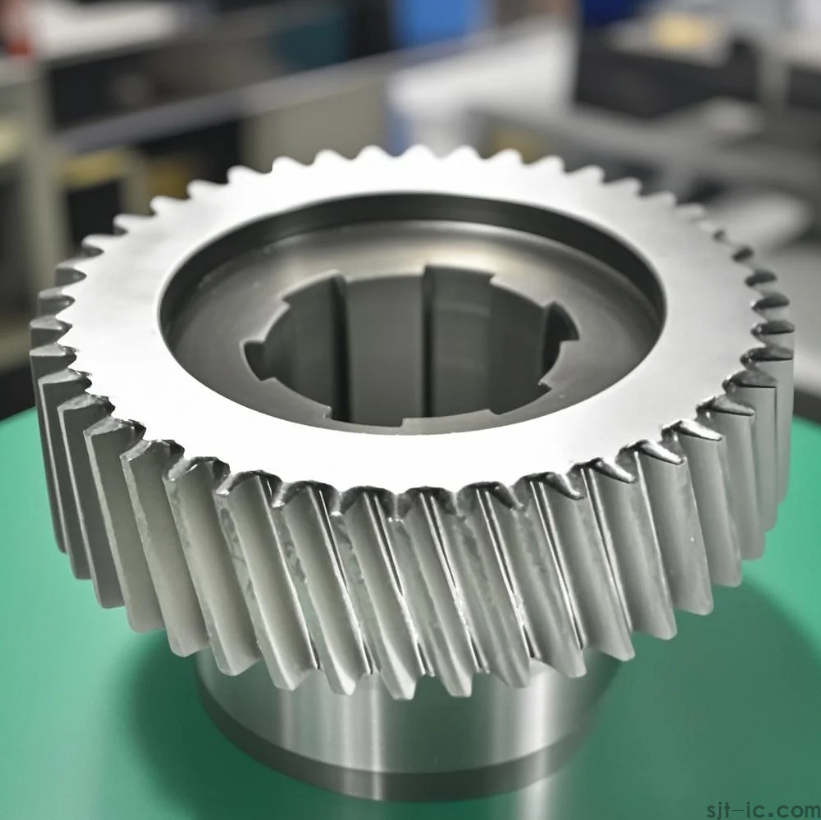
Large gears are critical components in industries such as mining equipment, wind power systems, marine machinery, construction machines, and heavy industrial drives. Because these gears often operate under high loads and continuous working conditions, even small errors in tooth shape or size can cause vibration, noise, energy loss, and early failure.
CNC Machining Large Gears provides an effective solution for producing large gears with high accuracy, stable performance, and consistent quality. With advanced CNC equipment and professional machining experience, manufacturers can create complex gear tooth profiles while maintaining strict dimensional control. Companies such as EMAR use modern CNC machining technologies to support customers who need reliable large gear production for demanding applications.
Large gears require extremely accurate tooth geometry because the teeth must transfer power smoothly between the driving and driven components. Traditional machining methods may struggle with the size, complexity, and precision requirements of large gears. CNC machining offers several important advantages.
For industries where equipment downtime is expensive, accurate CNC machining helps extend gear service life and improves overall machine reliability.
Proper design is the foundation of successful large gear manufacturing. Before machining begins, engineers must consider the operating environment, mechanical requirements, and manufacturing limitations.
The gear ratio determines the relationship between input speed and output speed. Engineers select the ratio according to the machine application. For example, heavy machinery may require a lower speed and higher torque output, while other systems may need faster rotation.
The design considerations for CNC-machined large gears include selecting the correct number of teeth, module size, pressure angle, and tooth width to achieve the required performance.
Large gears often transmit extremely high torque. The design must ensure that the gear teeth can withstand repeated loading without deformation or failure.
Important factors include:
The size of a large gear must match the available machining equipment. Engineers need to consider maximum workpiece diameter, weight capacity, machine travel range, and transportation requirements.
Early communication between the design team and CNC machining supplier helps avoid problems during production. Experienced manufacturers like EMAR can provide technical support from design review to final machining.
The material of a large gear directly affects its strength, durability, and operating life. The gear must resist heavy loads, repeated contact stress, and surface wear.
Material selection for large gear CNC machining usually focuses on three key properties:
Alloy steels are widely used for large gears because they provide an excellent balance of strength, hardness, and toughness. Common choices include materials such as chromium-molybdenum steels and nickel alloy steels.
After heat treatment, alloy steels can achieve high surface hardness while maintaining a strong core structure. This combination allows gears to handle heavy industrial loads while resisting fatigue and wear.
Manufacturing large gears requires several machining processes. Each operation has a specific purpose in creating accurate and durable gear teeth.
Hobbing operations in large gear production are commonly used for creating gear teeth efficiently. A rotating cutting tool called a hob removes material while the gear blank and hob rotate together in a controlled relationship.
Hobbing is suitable for many large gear applications because it provides:
Gear shaping uses a reciprocating cutter to form teeth. This method is useful for gears with special designs or when hobbing access is limited.
Grinding is a finishing process used when very high accuracy is required. It improves tooth surface quality, reduces friction, and helps achieve quieter gear operation.
Choosing the correct machining tools depends on:
High-quality cutting tools with proper coatings can improve tool life and maintain stable machining performance.
Large gears require carefully selected cutting parameters because their size and material can create machining challenges. Incorrect settings may increase tool wear, vibration, or thermal deformation.
Typical parameters include:
For example, alloy steel gears may require slower cutting speeds and controlled feeds compared with softer materials. CNC programmers adjust parameters based on gear size, tool material, machine rigidity, and required accuracy.
Handling vibration in large gear CNC machining is one of the most important challenges. Large workpieces have significant mass, and unstable cutting forces can create vibration that affects tooth accuracy and surface finish.
Common solutions include:
Large gears can generate heat during machining. Because of their large mass, uneven temperature changes may cause dimensional distortion.
Manufacturers control thermal problems by:
Producing consistent tooth quality across a large gear requires careful process control. Variations in machining conditions can affect tooth spacing, profile accuracy, and surface finish.
Professional CNC machining suppliers use precise measurement equipment and controlled processes to maintain uniform quality throughout the gear.
Heat treatment improves the mechanical properties of large gears. Processes such as carburizing, quenching, and tempering can increase surface hardness while maintaining core toughness.
This improves resistance to wear, fatigue, and heavy loading conditions.
Surface finishing processes improve tooth contact performance. A smoother surface reduces friction, lowers noise, and increases gear operating life.
Quality control in large gear CNC manufacturing ensures that every gear meets design requirements before delivery. Because large gears are expensive and difficult to replace, inspection is essential.
Important quality checks include:
Advanced inspection equipment helps identify potential problems early and ensures reliable performance in final applications.
Large gear manufacturing requires a combination of advanced equipment, skilled programming, material knowledge, and strict quality management. A capable CNC machining partner can help reduce production risks and improve gear performance.
EMAR provides CNC machining solutions for complex industrial components, including large gear manufacturing. With professional machining experience, precision equipment, and quality inspection processes, EMAR supports customers who need accurate and durable gears for demanding applications.
From design analysis and material selection to machining, finishing, and inspection, a complete manufacturing approach ensures that large gears achieve the strength, accuracy, and reliability required for long-term operation.